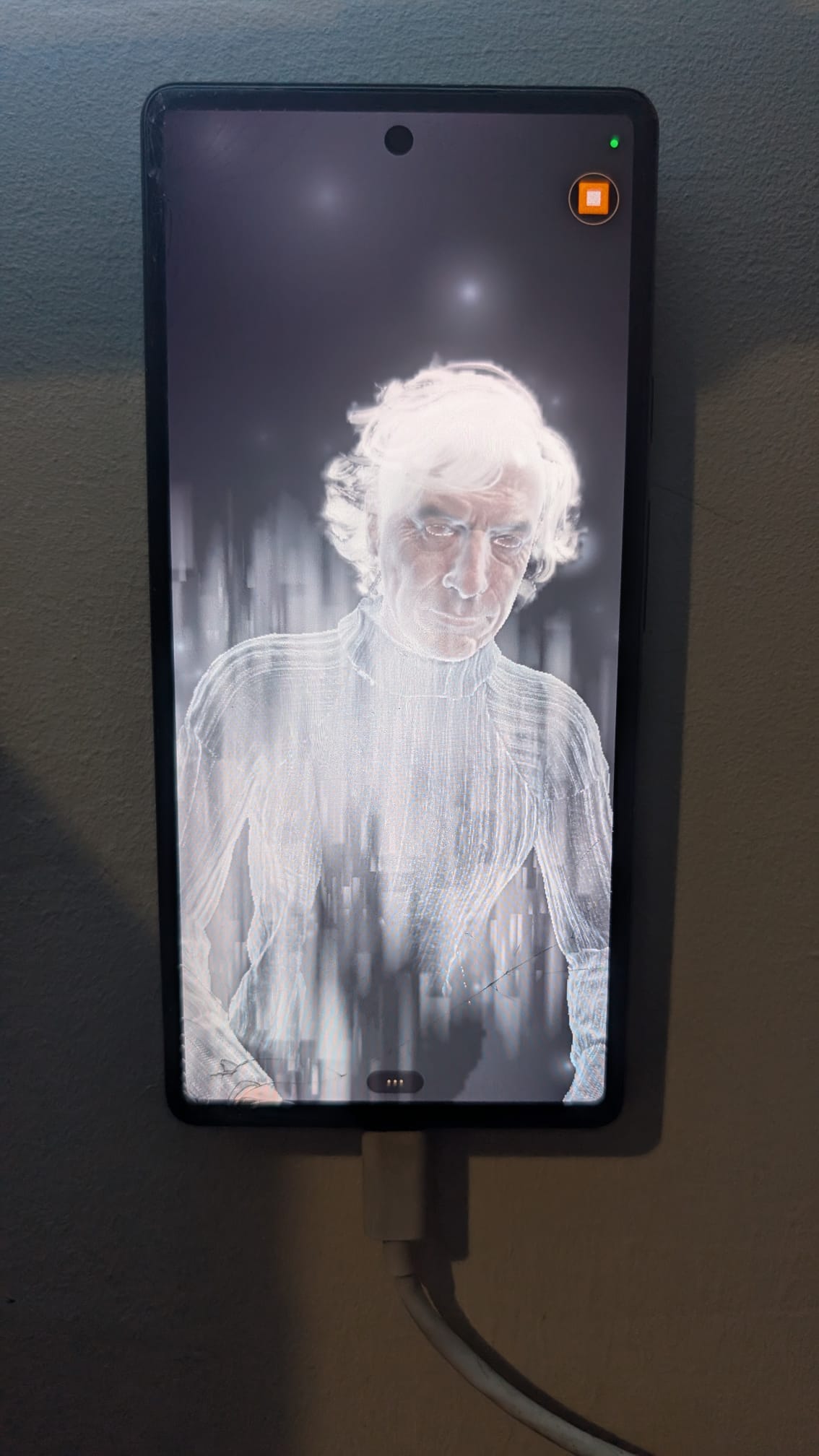
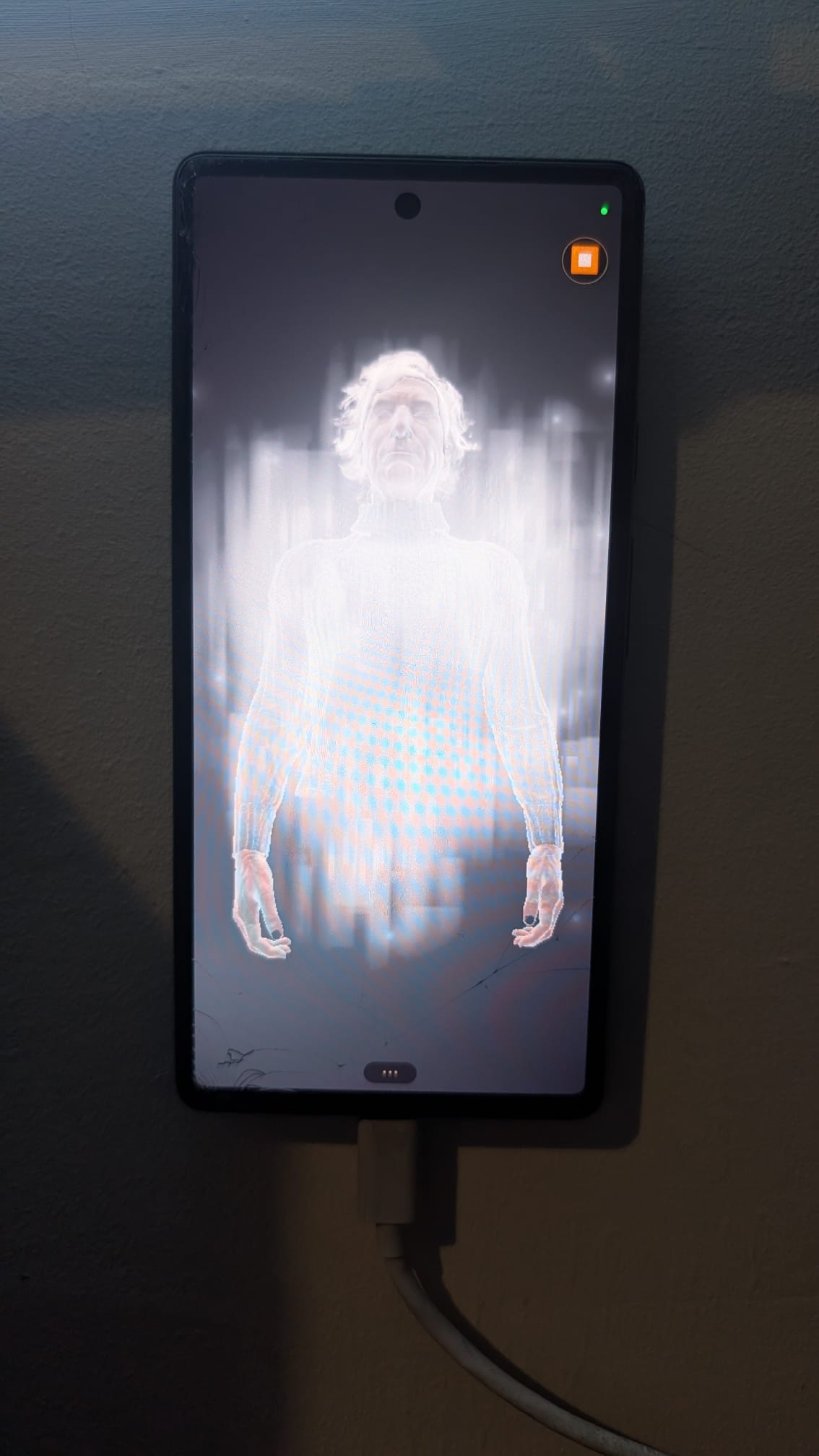
The wall is a Pixel 6, mounted on the office wall, running a slimmed-down version of the Harold avatar twenty-four hours a day. No scene around him — no virtual office, no bookshelves — just the ghost mesh on the warm plaster of the wall behind it. He breathes, he blinks, he glances when the wakeword fires. Most of the time he is quiet.
It is a different surface from the phone app, and Harold knows it. When you ask him what he can do, the wall answers in two or three sentences instead of the phone’s longer paragraph. He knows he is mounted; he knows he is always on. The system prompt for the wall surface includes its own identity stanza — I am the wall display in your office — and a list of the things this surface is good for and the things it is not.
The wakeword is Mr Graves, on-device, trained from a few thousand synthetic and real samples to fire on the right two syllables and stay silent for everything else. Threshold zero point eight five. Recall is excellent; the false-fire rate is acceptably small. When Mr Graves is heard, the wall lights its little dot; when nothing follows, it goes back to being a painting.
The hardware itself wants caring for. A Pixel 6 plugged in continuously climbs to one hundred percent and stays there, and a battery held at one hundred percent is a battery being cooked alive. So the wall’s plug is on a smart switch, and Home Assistant cycles it between forty and eighty percent of charge — twice a day, on average, the kind of cycle the lithium chemistry is happiest with. A stale-telemetry watchdog kicks the plug back on if the wall stops reporting for half an hour, in case the app has crashed. The screen brightness rises with the morning and falls into near-black at night. A pixel-shift drift moves the avatar a few pixels every minute so the OLED never burns the same image into the same well.
What the demo above shows is the small mundane test of it: a question about trains. The wall hears Mr Graves, the avatar looks up, the question is sent off, the answer comes back as text on the screen and as Harold’s voice through the device’s own speaker. The Echo speakers in the rest of the house stay quiet — the wall has its own throat. Trainline opens at the right station pair, dated for today. Forty-five seconds, end to end. It is not a magic trick. It is a domestic appliance that happens to be looking at you.
The pleasure of it is that he is there. Not a notification you have to unlock to read. Not an app you have to launch. Just a face on the wall, in the house he lived in until 1993, who knows your name and answers when you say his.